
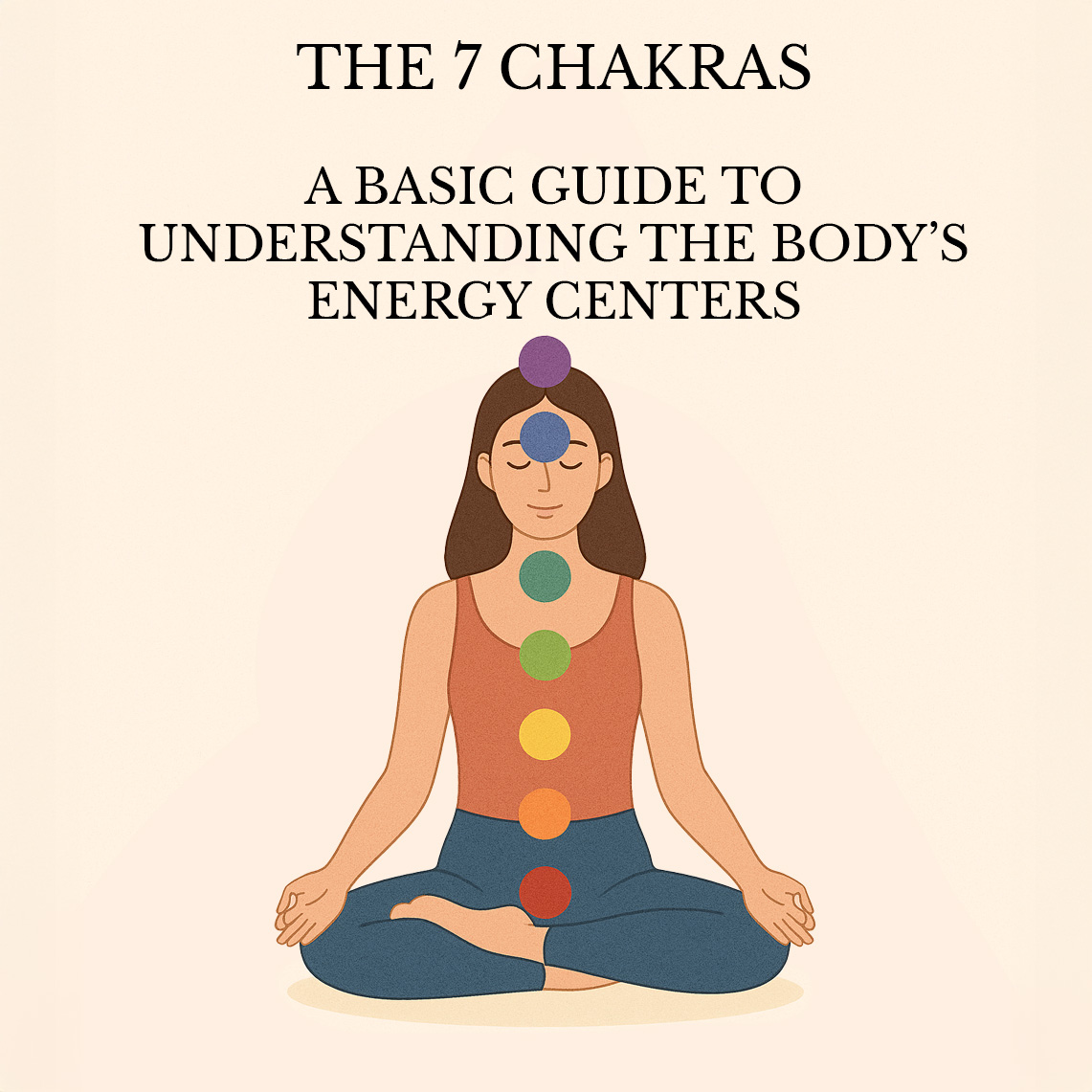
✨ What are chakras?
The word chakra means “wheel” in Sanskrit. According to yogic tradition, chakras are subtle energy centers located along the spine, each associated with specific physical functions, emotions, and inner qualities.
The main chakras are seven, and when they are in balance, we feel vibrant, centered, and in harmony.
🌀 The 7 chakras: positions, meanings and associated practices
1. Muladhara - Root Chakra
- 📍 Position: base of the spine
- 🌱 Keyword: security, stability
- 🧘♀️ Asana: Tadasana, Malasana
- 🎨 Color: red
- 🔊 Mantra: LAM
Muladhara, known as the Root Chakra, is the first of the seven chakras and is located at the base of the spine. It is the foundation of our stability, safety, and sense of belonging to the Earth. Muladhara represents the roots of our existence — the physical body, basic needs, survival, and our connection to everything tangible and grounded.
When this chakra is in balance, we feel safe, present, and able to face daily life with strength and determination. The body is connected to the present moment, the mind is calmer and our decisions are guided by a solid foundation. In contrast, an imbalanced Muladhara can manifest through anxiety, instability, a sense of disorientation or difficulty trusting life.
Working on Muladhara means returning to the body, to the earth, to deep breathing. It means learning to root yourself in the here and now, allowing each step to be supported by a solid and steady foundation.
2. Svadhisthana - Sacral Chakra
- 📍 Position: below the navel
- 💧 Keywords: creativity, sensuality, pleasure
- 🧘♀️ Asana: Baddha Konasana, Bhujangasana
- 🎨 Color: orange
- 🔊 Mantra: VAM
Svadhisthana, the Sacral Chakra, is located just below the navel and represents the center of our creative and emotional energy. It is where the ability to experience pleasure, allow emotions to flow, and connect deeply and sensually with others resides. Svadhisthana guides us to experience life with softness and fluidity, allowing us to dance with change instead of resisting it.
When this chakra is in balance, we feel inspired, open to joy, spontaneous and connected to our most sensitive part. We accept our feeling without judgment and cultivate nurturing relationships. In contrast, an imbalance in Svadhisthana can lead to emotional blocks, guilt, difficulty letting go or experiencing life's pleasures with authenticity.
Caring for Svadhisthana means embracing one's vulnerability, recognizing the beauty of desire and allowing ourselves to express who we are with gentleness and creativity.
3. Manipura - Solar Plexus Chakra
- 📍 Location: stomach area
- 🔥 Key word: strength, willpower, self-esteem.
- 🧘♀️ Asana: Navasana, Utkatasana
- 🎨 Color: yellow
- 🔊 Mantra: RAM
Manipura, the Solar Plexus Chakra, is located in the abdominal area, just above the navel. It is the inner fire that supports us in asserting who we are — the center of our willpower, autonomy, and self-esteem. From here arises the ability to make decisions, act with courage, and move through the world with intention and direction.
When Manipura is in balance, we feel determined, motivated and able to express our individuality with clarity and respect. We have self-confidence, act confidently and feel that we have power over our lives. On the other hand, if it is blocked or in excess, we may experience insecurity, need for control, suppressed anger or apathy.
Cultivating Manipura means feeding one's fire with awareness, transforming will into action and learning to shine without fear, staying connected to one's center.
4. Anahata - Heart Chakra
- 📍 Position: center of chest
- 💚 Key word: love, empathy, compassion
- 🧘♀️ Asana: Ustrasana, Bhujangasana, Setu Bandhasana
- 🎨 Color: green
- 🔊 Mantra: YAM
Anahata, the Heart Chakra, resides at the center of the chest and represents the meeting point between the material and spiritual dimensions. It is the subtle space where unconditional love, compassion, and the ability to give and receive without expectation arise. Anahata teaches us to open ourselves to life with tenderness, connect with others sincerely, and remain vulnerable without fear.
When this chakra is in balance, the heart is open, light, able to love itself and the world. We feel in harmony, present and welcoming. But if Anahata is closed or wounded, isolation, sadness, resentment, or fear of letting go in relationships emerge.
Working with Anahata means rediscovering the beauty of forgiveness, the value of kindness and the transformative power of love. It is an invitation to inhabit the heart, to listen to it and give it space, unconditionally.
5. Vishuddha - Throat Chakra
- 📍 Position: throat
- 🔵 Key word: communication, truth.
- 🧘♀️ Asana: Matsyasana, Sarvangasana
- 🎨 Color: light blue
- 🔊 Mantra: HAM
Vishuddha, the Throat Chakra, is the center of authentic communication, truth, and deep listening. Located in the throat area, it represents the bridge between what we feel inside and what we bring into the world through speech, song, or silence. Vishuddha invites us to express ourselves with clarity, to speak from a place of truth, and to share our thoughts without fear.
When this chakra is in balance, the voice is clear, language is conscious, and we are able to really listen to others without interrupting or judging. We communicate with integrity and also know how to remain silent when needed. If, on the other hand, Vishuddha is blocked, we may feel misunderstood, held back, or use speech excessively, rigidly, or distractedly.
Rebalancing Vishuddha means valuing one's inner voice, welcoming what we have to say and learning to do so with respect, simplicity and intention.
6. Ajna - Third Eye Chakra
- 📍 Location: center of the forehead
- 👁️ Keyword: intuition, inner vision
- 🧘♀️ Asana: Balasana, meditation, trataka
- 🎨 Color: indigo
- 🔊 Mantra: OM
Ajna, the Third Eye Chakra, is located between the eyebrows and serves as the center of intuition, inner vision, and subtle awareness. It is the point where mind and spirit meet — the place from which the ability to perceive beyond the visible arises, to listen to your inner guidance, and to see things with deep clarity.
When Ajna is active and in balance, the mind is clear, open, and able to grasp the hidden signals behind daily experiences. Insights become sharper, decisions more aligned, and a quiet confidence in one's inner wisdom develops. When it is out of balance, on the other hand, we may feel confused, mentally blocked or over-identified with rational thoughts.
Working with Ajna means stopping, observing without judgment, and trusting that subtle voice that speaks to us from deep within. It is an invitation to see with the eyes of the heart and consciousness.
7. Sahasrara - Crown Chakra
- 📍 Position: top of the head
- 💜 Keyword: spiritual connection, higher consciousness
- 🧘♀️ Asana: Padmasana, silent meditation
- 🎨 Color: purple or white
- 🔊 Mantra: silence or OM.
Sahasrara, the Crown Chakra, is located at the top of the head and represents the point of connection with the divine, the universe, and everything beyond the individual self. It is the center of higher consciousness, spirituality, and the deep understanding of life as unity. Here, the ego dissolves, giving rise to the feeling of being part of something greater — infinite and silent.
When Sahasrara is open and in balance, we experience moments of absolute presence, pure gratitude, and soul expansion. It is not a matter of moving away from reality, but of experiencing it with new eyes, recognizing the beauty even in the ordinary. On the other hand, when this chakra is closed or inactive, we can feel disconnected, lost, stuck in a materialistic and limited view of existence.
To cultivate Sahasrara is not to seek answers outside oneself, but to allow the inner light to emerge. It is a call to stillness, deep meditation, and trust in the mystery of life.
🧘 How to work with the chakras?
- Practice yoga by associating specific poses and colors with each chakra.
- Meditate by focusing on one chakra at a time, visualizing its corresponding color.
- Chant the mantra (bija) calmly and rhythmically.
- You can also use crystals, essential oils, or music tuned to 432 Hz.
Understanding and working with the chakras does not require dogma or rigid beliefs, but openness, listening and practice. When the chakras are harmonized, we feel more present, vital and connected to who we really are.